


INSIGHTS
The buzz around AI in marketing has shifted from "will it happen?" to "why is it taking so long to work?".
Brands should not have to choose between deep internal knowledge and fresh external thinking.
Deep brand knowledge is valuable. So is someone asking why you still do things that way. The ZITE model combines everyday proximity with fresh perspectives, specialist skills and creative friction.
You can tell a lot about a setup by its file names. If “final_v7_THIS_ONE.psd” still exists, chances are things take time. Somewhere else, teams are producing thousands of assets a year without breaking stride — not because they work harder, but because they’ve rebuilt how production actually works.
In-house teams have grown in size, scope and ambition. Strategy, governance and operations have not always kept pace. The next chapter is about strengthening the machinery beneath the output.
AI er ikke magi. Det er en ordentlig brief.
Langt de fleste bruger AI luddovent. To linjers prompt. Halv brief. Fuld forventning. Vores erfaring? Det er ikke modellen, der afgør kvaliteten. Det er strukturen omkring den.
Det er ikke rocket science. Men fordelen ligger i at man nu selv kan bygge noget småt, der løser et konkret problem.
Og det er dér, den rigtige in-house fordel ligger.
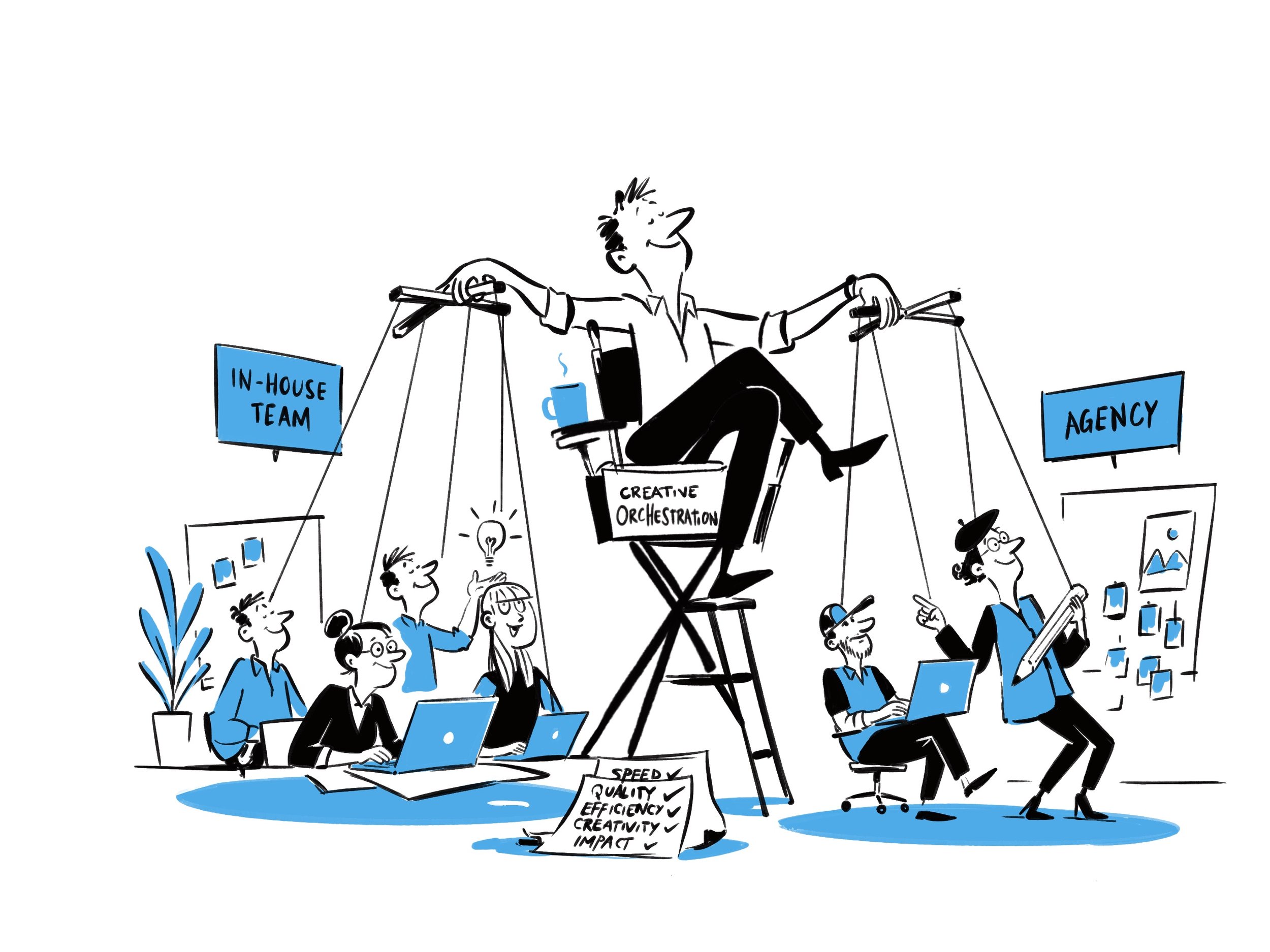
An internal team knows the brand. An external agency brings perspective and specialist talent. The interesting question is not which one to choose—but how to make both work together.
In-house or external? It’s the wrong question.
The smartest brands aren’t choosing one over the other. They’re building creative systems that give them both – speed, control, and consistency from the inside, with the strategic lift and perspective of the outside. This article explores how hybrid models work in practice, and why letting external partners build your in-house setup might be the smartest move you make.
What if the best way to go in-house… is to ask someone outside to build it?
This article explores the rise of external agencies running in-house teams — not as service providers, but as system architects. From incubator models to embedded leadership and full operational takeovers, it’s a smart, scalable way to build internal creative power without starting from zero. Not a paradox. A playbook.
The most effective creative setups today aren’t in-house or external. They’re both.
This article explores the rise of on-site agencies — external partners embedded inside the organization — and why they’re outperforming traditional models by combining brand intimacy with creative friction. Based on insights from the 2025 In-House Barometer, this is what the hybrid future of marketing really looks like.
Some in-house teams are deliberately established by management. Others grow quietly, one role and responsibility at a time. The route taken shapes the team, its mandate and its future challenges.
We have taken a deep dive into the numbers of prestigious industry awards the data underscores the significant rise of in-house agencies over the past decade. At the Cannes Lions International Festival of Creativity, the growth of in-house participation and success is particularly striking.
The traditional divide between in-house marketing teams and external agencies is rapidly dissolving. At ZITE, we’ve observed firsthand how in-house agencies are transforming from corporate support functions into vibrant, creative powerhouses. Our latest endeavor, the 2024 In-House Barometer Study, delves deep into this transformation, revealing how in-house teams are not just adapting but leading the charge in creative and strategic innovation.
The perennial debate of in-house versus outsourced marketing continues to puzzle companies of all sizes. Each approach boasts its own unique advantages and drawbacks, leaving you to ponder which truly aligns with your specific needs and objectives. However, a crucial element often overlooked is the importance of actively measuring and comparing the efficiency of both models.
The 2024 In-House Barometer Study reveals an intriguing correlation: Larger companies often boast more extensive in-house teams.
Companies bringing their marketing efforts in-house is a growing trend in recent years. From social media and content creation to media buying and campaign development, businesses are investing in talent to handle these tasks internally. This shift has proven successful for many companies in terms of both creative campaign awards and effectiveness, as it keeps marketing efforts closer to the core of the business.
However, in-house marketing teams sometimes struggle to find time for creativity and a fresh perspective. To better understand the current state of in-house marketing, we conducted this study, receiving more than 1,200 responses from the European business world. This report aims to gauge their thoughts and feelings about in-house marketing, to identify differences between in-house and outsourced marketing work, and to uncover both models’ perceived advantages and disadvantages.
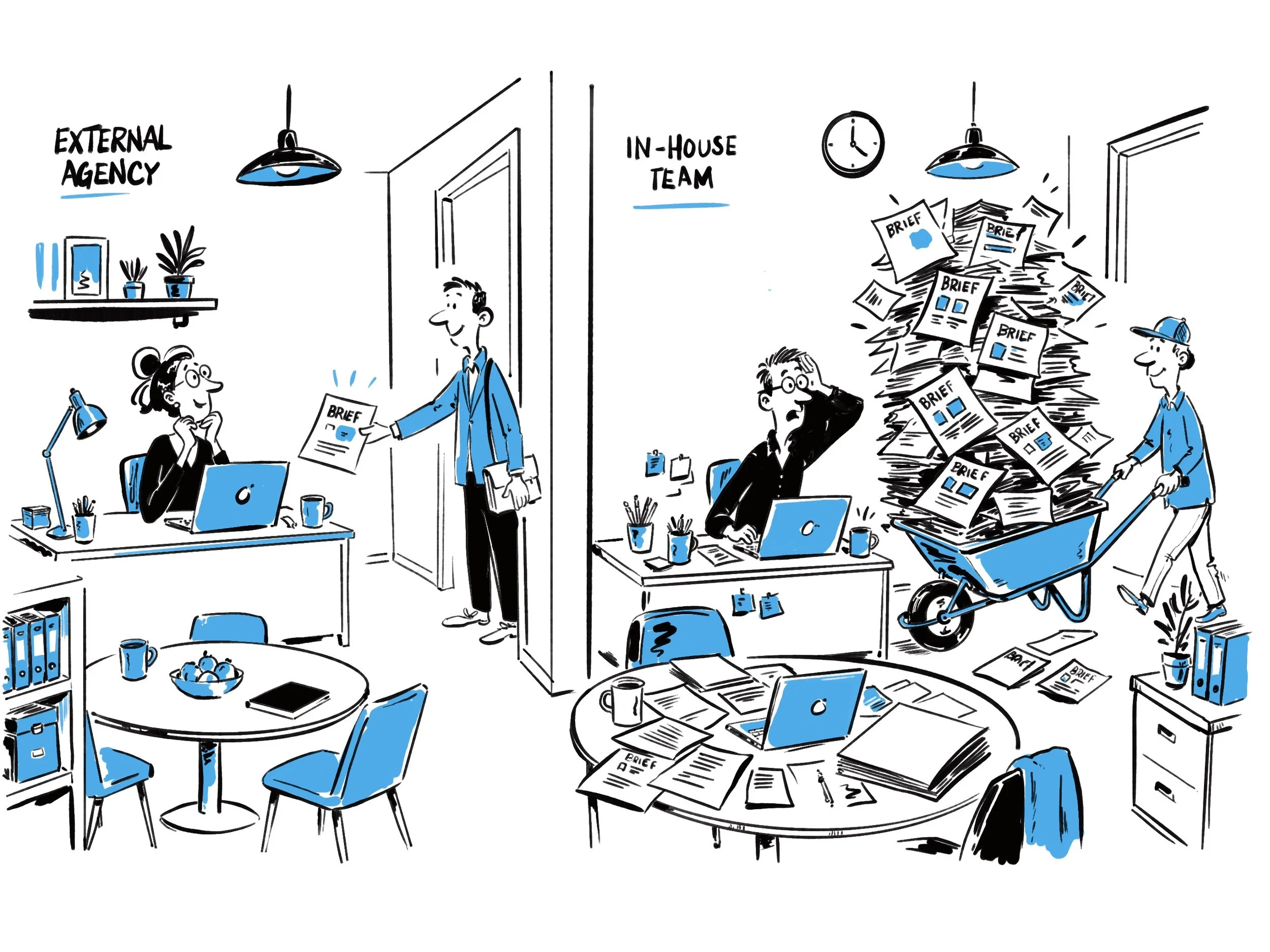
It is no easy task to run an agency, whether it is in-house or a traditional agency. But from our experience, in-house setups often face other challenges compared to their external counterparts.
So, we asked the teams to identify the greatest challenges they currently face. Here are the Top Ten Challenges in order of frequency:
Marketing teams worldwide are doing okay, but "okay" isn't enough. A recent study by the WFA shows we can do much better if we focus on teamwork and measuring our success the right way. Here's a friendly guide to help us all step up our game
Have you ever tried to solve a puzzle, only to find a piece missing? Frustrating, isn’t it? The world of marketing often feels akin to this—a jigsaw puzzle with that one elusive piece always just out of reach. Could co-creation be the piece we've been so fervently searching for?
Creativity is the lifeblood of innovative marketing campaigns. Yet, as in-house teams expand and the weight of corporate culture sets in, that vibrant creative pulse can start to wane. Remember, sometimes, two heads truly are better than one.
In the quest to optimize budgets without sacrificing quality, CFOs and procurement professionals are turning to the "In-house Agency as a Service" model. Offering a unique blend of cost-effectiveness and specialized expertise, on-site agencies are redefining the value proposition in marketing expenditure.
The modern digital landscape has blurred the lines between in-house marketing teams and external agencies. "In-house Agency as a Service" emerges as a transformative solution, merging the intimacy of internal teams with the expertise of external agencies. This model is not just a cost-saving measure; it's a strategic move for professionalising in-house marketing operations, ensuring rapid scalability, and leveraging the best of MarTech tools.
As businesses further embrace MarTech and AI, the intertwining challenge of compliance grows stronger. These powerful tools that shape our digital experiences bring with them responsibilities that businesses can't afford to neglect. At the heart of this is the novel solution: on-site agencies.
Traditionally, corporations have been stuck in a dilemma. External agencies, while bringing in a fresh perspective, often come with high overheads, unpredictable costs, and occasional misalignment with the company's core values and objectives. On the other hand, entirely in-house teams can sometimes lack the specialized skills or the latest market insights.
This inconsistency not only impacts the financial health of the organization but also leaves CFOs in a constant quest for a more sustainable, predictable, and quality-centric solution.
The Need for Scalability in Dynamic Business Environments. In an era of rapid technological change and unpredictable market dynamics, the ability to scale business functions has become paramount. This is especially true for marketing, a domain perpetually in flux, where brands are constantly vying for consumer attention. Today, companies can't just be good—they need to be agile and scalable.
The digital transformation wave has impacted various facets of businesses, reshaping how they function and serve their customers. As a core function, marketing has yet to be untouched in many companies. But now, the traditional boundaries of in-house teams and external agencies are blurring. Enter the concept of the "In-house Agency as a Service.
In recent decades, we've been witnesses to a series of revolutions in the business world. Digital transformation, for one, has rippled across industries, heralding changes in the way businesses operate and serve their clientele. Today, we stand on the cusp of another seismic shift—one that may forever alter the marketing landscape.

