Your Approval Process Is Part of the Creative Product
Better creative work needs scrutiny. It also needs a distinction between fixing a problem and adding another person’s preference.
Consider a campaign with one clear idea. Sales asks for a second benefit. A product team adds a technical detail. A regional stakeholder needs a local message. Legal questions a claim. Each comment deserves attention, but they do not all ask the same thing. Some correct an error. Some change the brief. Some express a preference. Treating them as equivalent instructions is how a clear idea can become a crowded one.
The 2026 In-House Barometer asks respondents about their clients’ biggest barriers to creative risk-taking. Convincing non-marketing stakeholders to take creative risks is selected by 25%, while 24% point to fear of doing something different. A further 19% identify insufficient understanding of what good creativity looks like, and 14% select the dilution of bold ideas during development.
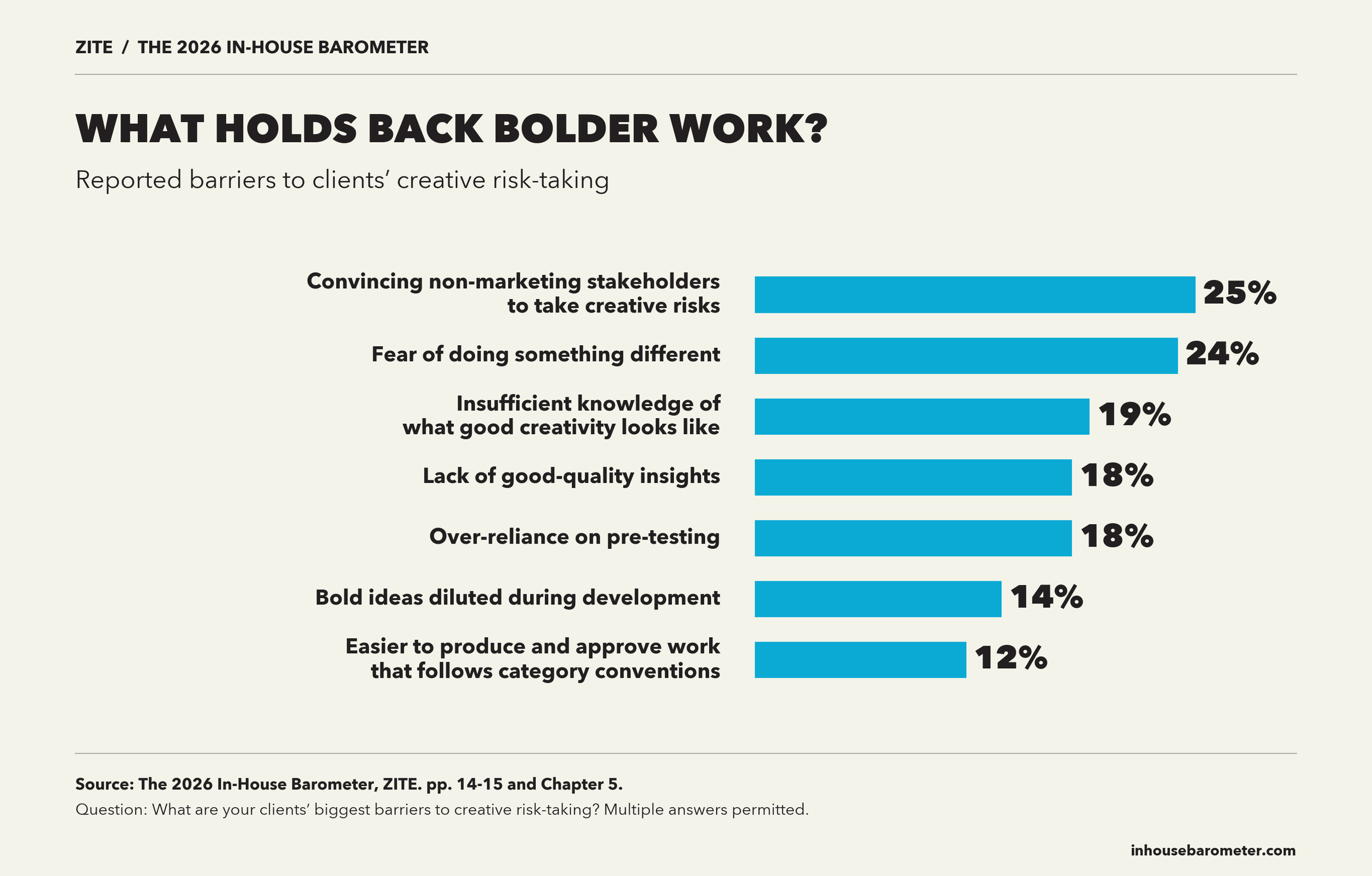
These are reported barriers to clients’ creative risk-taking, not a count of stakeholders or a measure of how often all creative work fails.
These figures describe reported barriers to risk-taking. They do not measure how many stakeholders are involved, and they do not establish that stakeholder feedback is generally harmful. The more useful reading is that developing an idea and getting permission to use it are connected but different challenges.
More feedback is not the same as better scrutiny
Commercial and legal scrutiny belongs in creative work. A distinctive idea that misrepresents the product is not a good idea. The problem is less the existence of scrutiny than the absence of agreed criteria for applying it. Without those criteria, the team can spend each review trying to work out whether a comment is a requirement, advice or an instruction from somebody senior. 2
The brief should therefore establish more than the deliverables. It should identify the business problem, the audience, the central proposition and the conditions the work must satisfy. It should also name the final decision-maker. That gives the review a basis beyond whether each participant personally likes the execution.
Timing matters as well. Product, legal and market requirements are easier to accommodate when they are understood during development. Introducing them after the central idea has been approved can turn a correction into a redesign. The aim is not to stop people contributing. It is to involve them while their contribution can improve the answer without repeatedly restarting it.
Protect the idea without making it untouchable
Creative leadership needs to distinguish what can change from what holds the idea together. A line may need rewriting. A visual may need adapting. A claim may need removing. None of those decisions should automatically reopen the entire strategy. Equally, protecting the idea cannot mean ignoring evidence that it fails to address the brief.
A useful review separates three questions. Is the work correct? Does it answer the brief? Is the creative response strong enough? The people contributing to each question may differ. The process should make those responsibilities visible and bring the answers together, rather than asking everyone to approve every aspect of the work. This is a proposed review structure, not a score or model tested by the survey.
Feedback tools can support that structure when comments attach to the right asset and version, decisions are recorded and resolved issues stay resolved. They cannot make an unclear approval mandate clear on their own. The organisation still needs to decide who can request a change, who evaluates it and who signs off.
The conditions around creativity are part of the job
This is where creative leadership and operations need each other. The creative lead protects the standard and integrity of the work. Operations makes sure the right people see it at the right stage, review time is planned and decisions reach the people producing the next version. Neither discipline replaces the other.
For an embedded agency such as those ZITE designs and runs, that connection is central to the model. Being close to the business provides access to its knowledge and decision-makers. A designed workflow helps turn that access into useful input rather than permanent interruption.
The next time a campaign reaches final approval, look back at its original brief. Which changes made the work more accurate or more relevant? Which changed what it was trying to do? The distinction is worth discussing before the next campaign starts. Better approval is not less accountability. It is a clearer agreement about what everybody is accountable for.
Read more about the organisational creative block in the 2026 In-House Barometer.