58% vs 28%: Who Has Compared In-house and Agencies?
The striking finding is not which model performs better. It is who has examined the alternatives in the first place.
The discussion about in-house often arrives with a preferred answer. One person wants a permanent internal team. Another wants a lead agency. Someone else proposes AI before anybody has described the work. There is a more useful place to begin: has the organisation actually compared the alternatives?
In the 2026 In-House Barometer, 58% of respondents in organisations with in-house resources report having compared the efficiency of internal and external agency models. Among those without in-house resources, the figure is 28%. The first group is therefore roughly twice as likely to report a comparison.
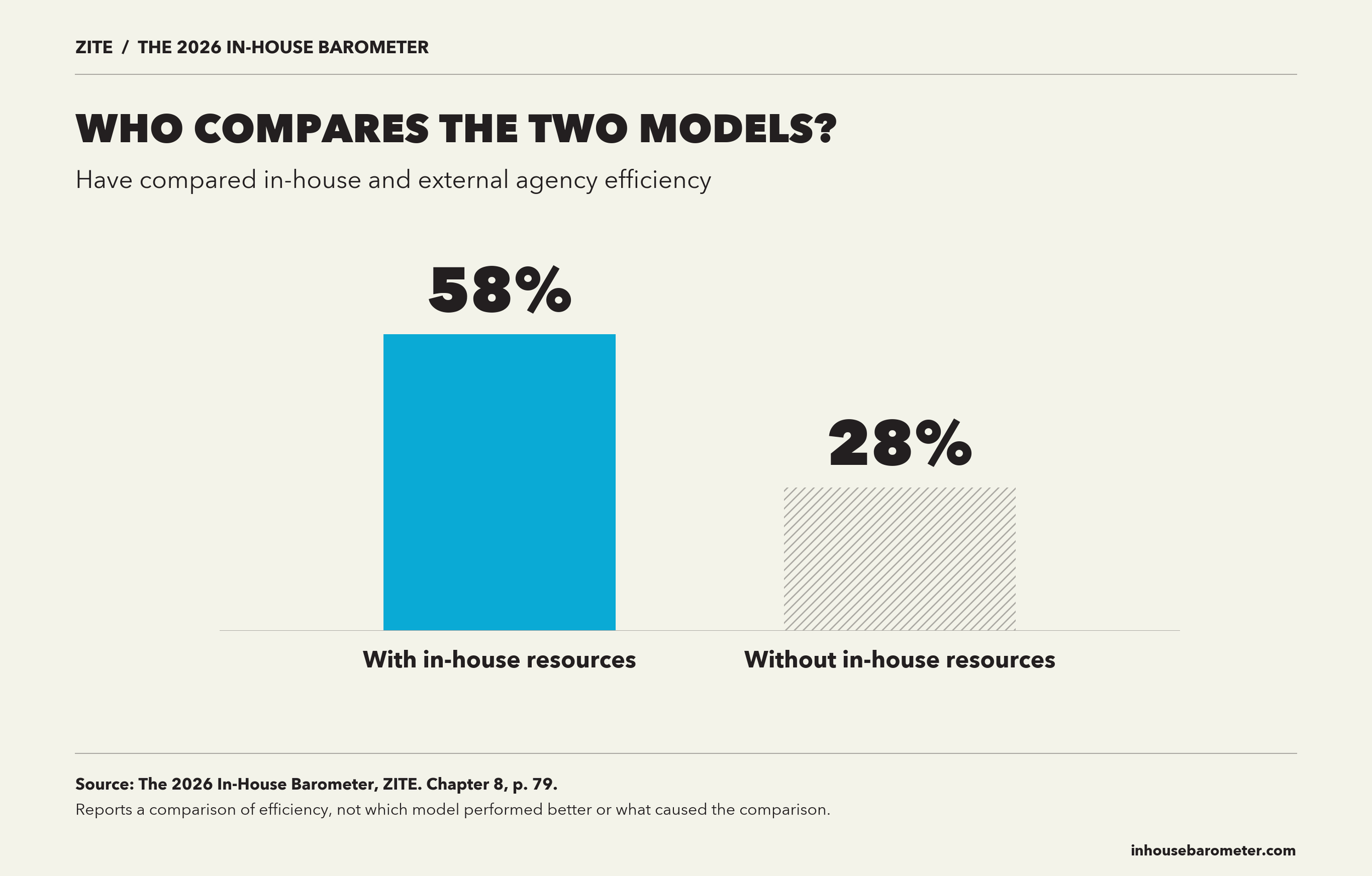
The finding concerns whether organisations have compared the models. It does not establish which model is more efficient or whether comparison preceded in-housing.
The result does not tell us which model came out ahead. It does not prove that bringing work inside makes organisations more analytical, either. A comparison may have helped a company decide to establish its internal team. It may also have happened afterwards. The survey establishes an association, not the sequence of decisions.
Compare the work, not the ideology
An efficiency comparison becomes useful when it starts with a defined assignment. Recurring adaptations, a new brand platform and a specialist film production involve different demands. Grouping them into a single category called marketing can conceal the reasons one route works better for a particular task.
For recurring work, internal knowledge and continuity may reduce the need to explain the same product or brand repeatedly. For specialist work, an external partner may offer expertise that would be expensive to maintain between assignments. For fluctuating demand, flexible capacity may matter more than the lowest hourly rate. These are design choices, not declarations of loyalty to one model.
A sensible comparison therefore examines the whole route to usable work. Internal costs include leadership, systems and the time spent reviewing and coordinating, not just salaries. External costs include the client’s briefing and review effort as well as the invoice. An apparently cheap route can become expensive if it repeatedly creates corrections or leaves the internal team joining everything together.
Equally, a higher production cost may be justified by better specialist execution or a stronger answer to the business problem. Efficiency is not a licence to ignore effectiveness. A comparison that rewards only the cheapest asset risks optimising something the audience never notices.
Hybrid is a practical option, not a consolation prize
The report also finds that 44% of organisations with in-house resources use external agency partners, rising to 50% among large organisations with internal capability. External collaboration and in-house resources therefore coexist in a substantial part of the sample. This does not mean every company should build the same mix. It means that internal capability and external expertise are not mutually exclusive.
The key is to retain enough knowledge and judgement to direct the combination. An internal creative lead may own the central idea while a specialist agency develops part of the campaign. A production partner may handle agreed adaptations. AI may support a defined step. The responsibilities for the brief, feedback and final approval should be settled before the handovers begin.
Internal ownership does not require a homemade operating model
There is another choice hidden inside the discussion: who runs the setup? Knowing the business does not automatically provide experience in creative resourcing, workflow design or production planning. A company can keep a dedicated team close while bringing in an operator with those skills. That is the model ZITE uses when it builds and runs embedded agencies backed by its processes, technology and wider specialist network.
This is not an argument for outsourcing judgement. It is an argument for being precise about which judgement needs to sit where. Business priorities belong with the business. Creative standards need qualified leadership. Running the system requires operational expertise and reliable tools.
Before debating the preferred model, choose a representative slice of work and compare the available routes. Record the scope, total effort, turnaround, quality requirements and coordination involved. The exercise may confirm the existing arrangement. It may reveal a better one. Either result is more useful than treating last year’s supplier list as a strategy.
Explore the evidence on internal capability and external partners in the 2026 In-House Barometer.