The AI Demo Is Over. Now Somebody Has to Run It.
Only 22% of respondents assessing content quality report an improvement. Making AI useful takes more than making it generate.
The demo ends with a good image and a room full of possibilities. Then somebody asks whether it can be used in the next campaign. Is the product shown correctly? Is the claim approved? Which market is it for? Can the next person reproduce the result? The conversation has moved from what the technology can generate to what the organisation can actually publish.
That distinction runs through the 2026 In-House Barometer. Among the 778 respondents who assessed AI’s effect on marketing content quality, 22% report an improvement. In a separate question about creative roles, 52% expect AI to complement and enhance human creativity. These are different questions with different respondent bases, not a before-and-after comparison. Together, they show that expectations for AI can be stronger than the quality improvements reported today.
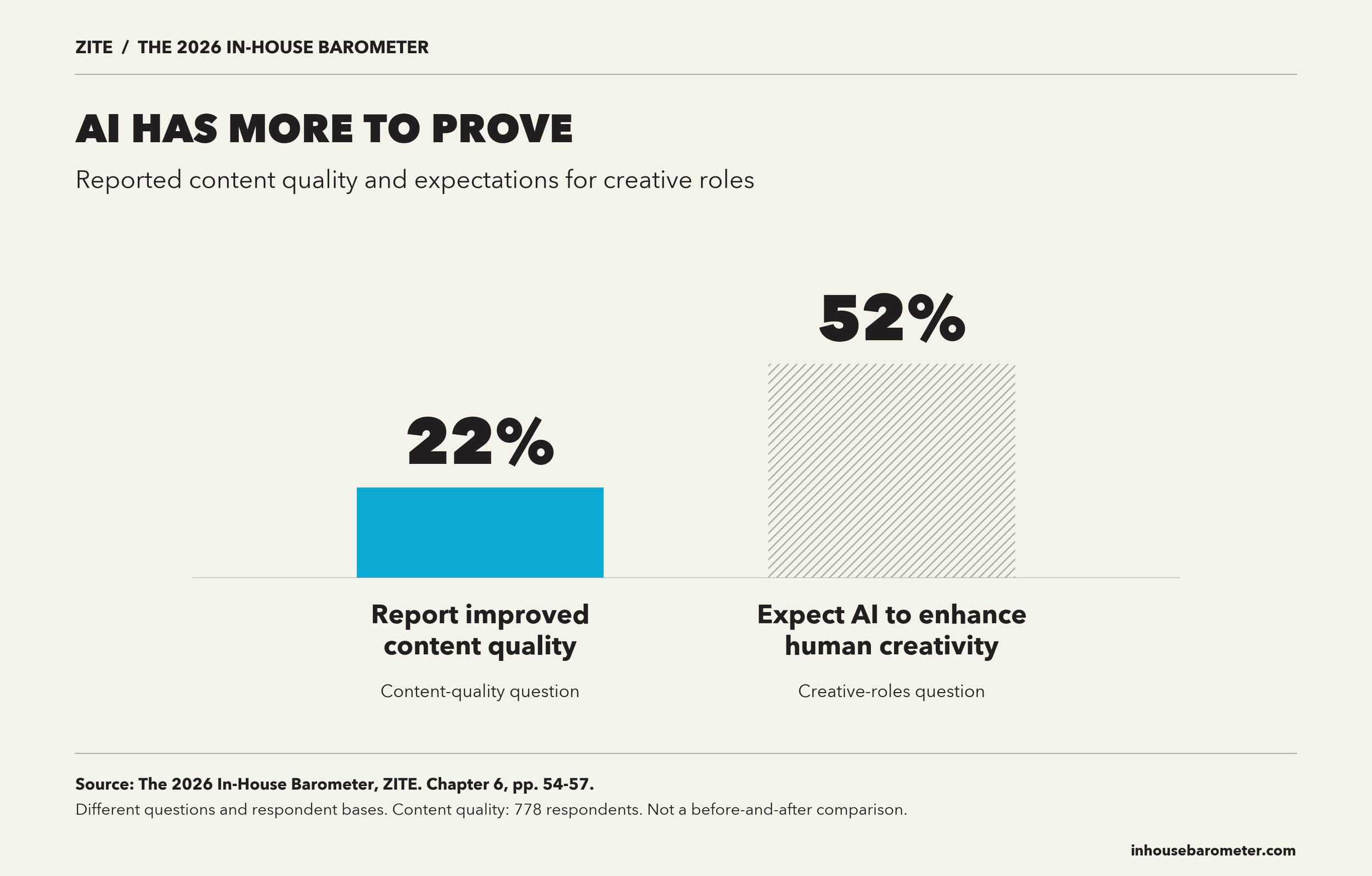
Present experience and future expectation answer different questions. The results must not be read as a single sample changing over time.
There is no need to conclude that the technology has failed, or that the answer is simply to wait for a better model. The management question is more useful: what has to happen between generating something and approving it for use?
The first draft is only one stage
Consider a product campaign adapted for several countries. Generating the drafts may be quick, but someone still has to supply the correct specifications, identify approved claims, check translations and make sure the variants belong to the same brand. An attractive output can be unusable because it quietly changes a detail that matters. A fast first draft is valuable only if the rest of the process can handle it.
That is why the unit of improvement should be the complete assignment, not the isolated prompt. A practical pilot should track how much usable work reaches approval, how often outputs need correcting and how much review time the process requires. Faster generation and faster delivery are related questions, but they are not the same measurement.
Guardrails need to be part of the workflow
Asked what is necessary for successful AI adoption, 32% of respondents select AI-skilled personnel, 29% governance policies, 26% alignment with organisational goals and 20% infrastructure. Among large organisations, 34% identify governance, compared with 25% among smaller businesses. These are stated requirements, not proof that those organisations have already implemented them.
The practical implication is to make the rules usable. Teams need to know which tools are approved, what information may be supplied, which sources are authoritative and who reviews the result. Approved brand and product information should travel with the assignment. A policy document sitting somewhere else is of limited help when somebody is choosing between six plausible outputs.
The same applies to learning. A useful prompt, a rejected claim or an approved approach should not disappear into a private chat history. Keeping that knowledge available lets the next person build on the decision rather than repeat the experiment. This is one of the places where an in-house team’s closeness to the business can become a practical advantage.
Creative judgement stays in the process
The ability to generate alternatives does not settle which alternative is worth using. Creative leadership still has to judge whether the work says something useful, whether it is recognisable and whether it deserves the audience’s attention. The purpose of automation should be to support that judgement, not bury it under more options.
In the report’s foreword, I write that the most interesting AI story may be “the organisation being built around it”. This is where Creative Orchestration becomes concrete: people, approved information, tools, review and final accountability are connected instead of being left to the individual who happens to know the best prompt.
ZITE’s work on in-house structures brings people, processes and technology together. Applied to AI, the same operating discipline means deciding where generation belongs, what humans must check and how the result becomes usable by the rest of the team. 5, 2
Start with one recurring assignment and follow it all the way to an approved asset. That is a more useful test than another impressive demonstration. The real milestone is not that AI can make something. It is that the organisation knows when, how and whether to use it.
Read the AI findings in the 2026 In-House Barometer.