

The work nobody planned for
When internal demand grows faster than the system built to manage it
The in-house model is often associated with speed. Internal teams sit closer to the business, understand the brand and can respond without the handovers involved in briefing an external partner. That proximity is one of the model’s greatest advantages.
It is also one of its greatest sources of pressure. When the creative team is visible, accessible and already inside the organisation, every department knows where to take the next request. A local campaign needs adapting. Sales wants a presentation for an upcoming meeting. A senior stakeholder has seen a competitor do something interesting. An event has been moved forward. A product message needs changing across every channel by Friday.
Each request may be reasonable on its own. The difficulty appears when they arrive together, through different routes and with no shared view of what should come first.
The 2026 findings show that workload continues to rise, but the deeper issue is not simply the quantity of work. It is how much of that work enters the system without sufficient planning, prioritisation or clarity. In-house teams are not only producing more.They are absorbing more of the organisation’s uncertainty.
Workload growth has become structural
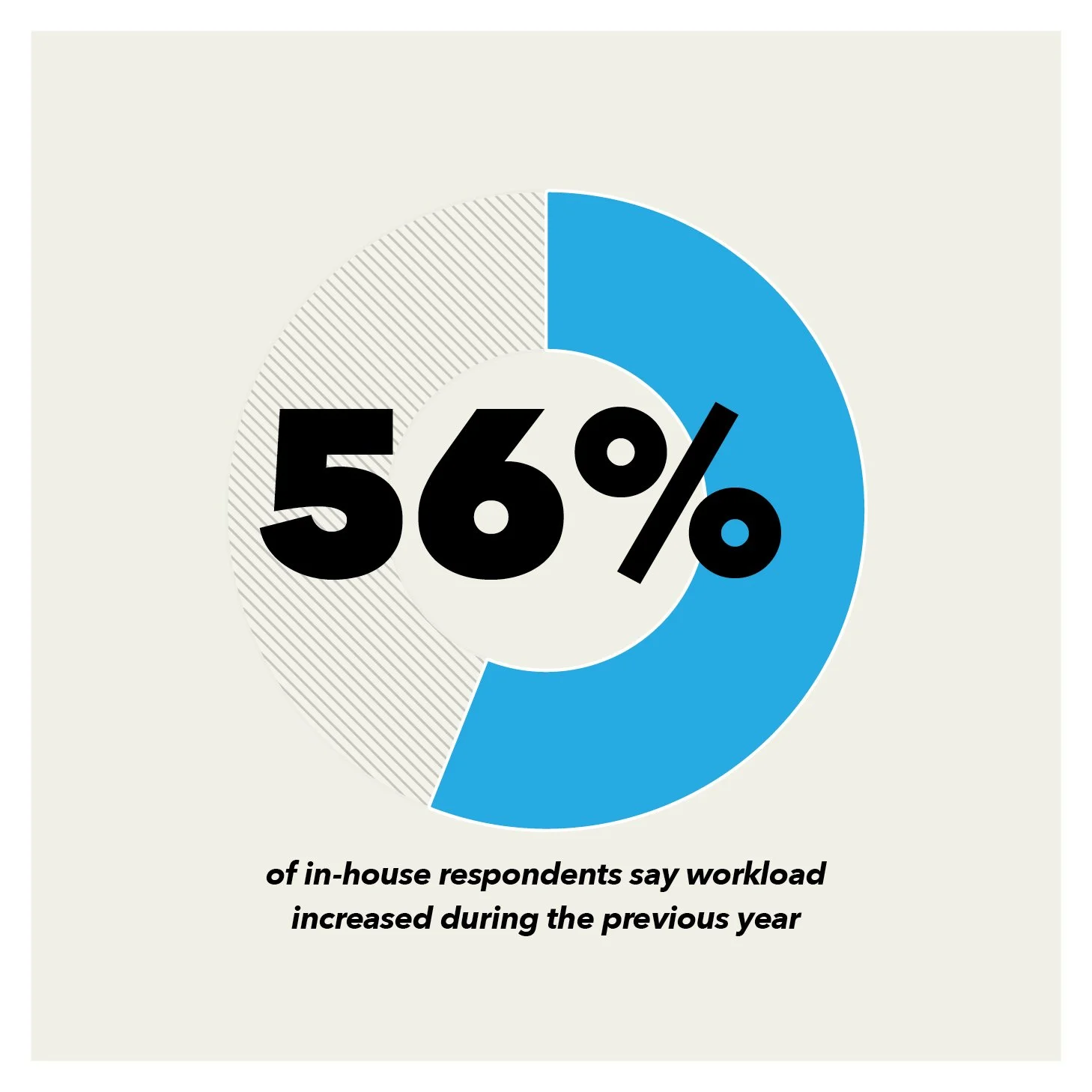
Fifty-six per cent of in-house respondents say their workload increased during the previous year.
This is not a temporary spike appearing after a quiet period. It follows the same pattern seen in the 2025 Barometer, when 54% reported increasing workload.
The consistency matters. When more than half of internal teams report rising demand year after year, growth can no longer be treated as an exceptional workload problem. It is becoming part of the operating environment.
The reason is not difficult to find. In-house teams are taking responsibility for a wider range of disciplines while maintaining their existing production commitments. They are closer to more stakeholders, involved in more channels and increasingly expected to contribute both strategic thinking and rapid execution.
Technology also changes what the organisation believes should be possible. When content can be drafted, resized, translated or adapted more quickly, the apparent cost of requesting another version falls. The time saved on one task can quickly be filled by three new ones.
Capacity increases. Demand notices. This is why greater productivity does not necessarily result in a calmer team. It can simply raise the volume the organisation expects the team to handle.
Nearly two working days out of five are absorbed by work the team did not originally expect to handle.
Nearly two working days out of five are unplanned
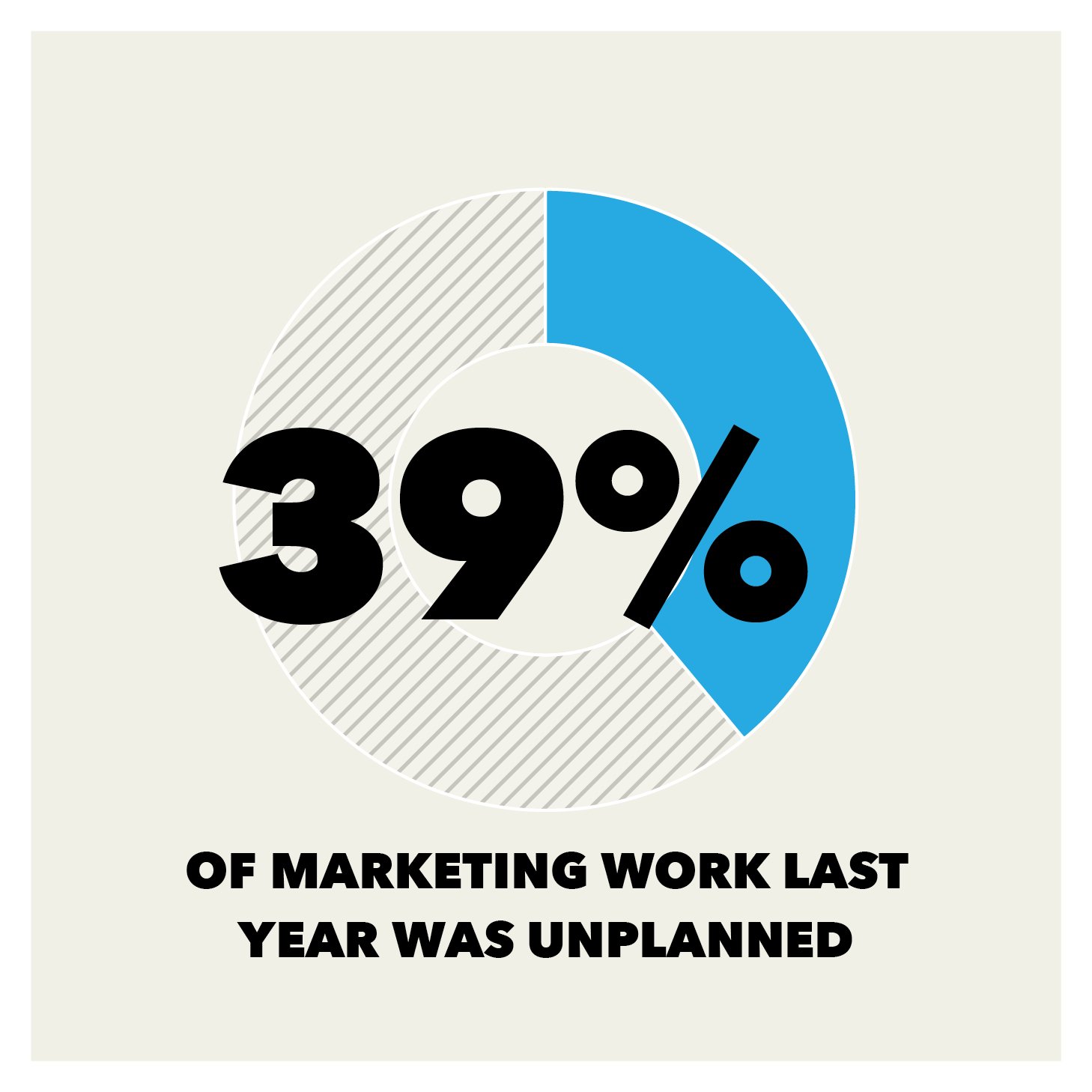
Among in-house teams, only 61% of work was planned in advance. The remaining 39% arrived outside the original plan.
That means almost two out of every five tasks were added after priorities, resources and timelines should already have been established.
Some unplanned work is unavoidable. Markets move, competitors act, products change and businesses encounter opportunities that could not have been placed in an annual calendar months earlier. A responsive internal team exists partly to deal with those moments.
The problem begins when reactive work is no longer the exception. When almost 40% of the workload is unplanned, the annual plan stops being a reliable description of what the team will actually spend its time doing. Permanent resources may be allocated against one set of priorities while the working week is consumed by another.
That affects more than delivery dates. It reduces the space available for strategic projects, creative development and proper evaluation. It encourages the team to favour work that can be completed quickly and visibly, while larger assignments are repeatedly moved to make room for whatever has just arrived.
Unplanned work does not merely sit beside planned work. It interrupts it.
The hidden cost of interruption
A reactive assignment rarely consumes only the time required to produce the final asset.
Someone must understand the request, find the relevant information, identify the correct version, confirm the deadline and work out which existing commitment should move. The task then enters review, where more stakeholders may become involved and the original request may begin to change.
A “small update” can create a surprisingly long trail through the organisation.
The cost is not only the minutes recorded against the job. It is the repeated shift in attention. Strategists stop investigating the larger problem. Creative teams leave ideas half-developed. Project managers rebuild plans that were already agreed.
When that happens occasionally, it is part of normal business. When it happens continually, the team becomes organised around interruption.
This creates the appearance of constant activity. Work is moving, messages are being answered and deadlines are being met. But the organisation may be using a highly capable team to solve whichever problem arrived most recently rather than whichever problem matters most. Busy is visible. Priority is harder to see.
A weekly flow of briefs, not occasional projects
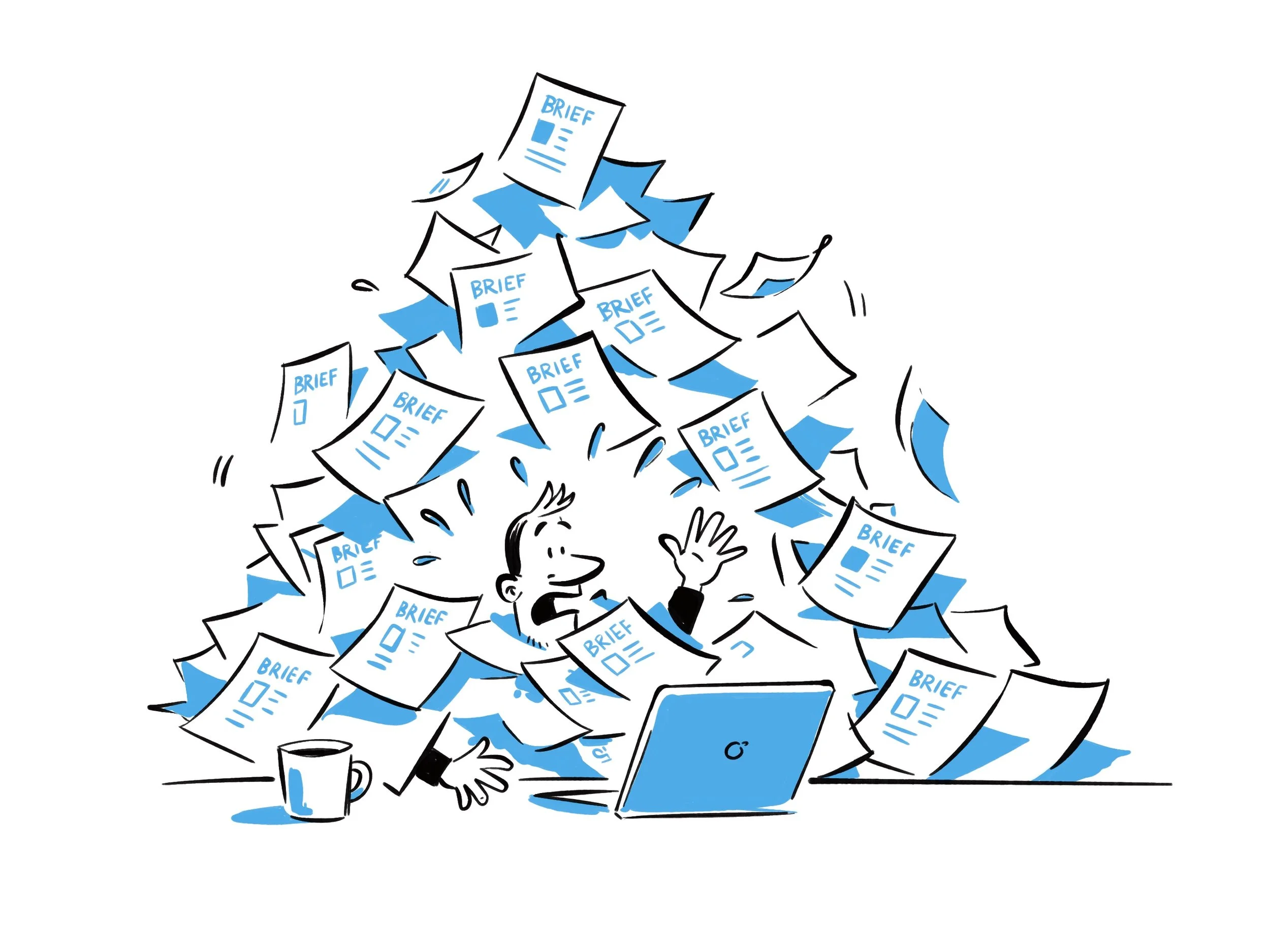
The workload data shows that internal teams are dealing with a continuous stream of assignments. Around seven in ten respondents who answered the question completed at least 11 tasks or briefs in the previous week. Five per cent handled more than 30. These numbers should not be read as 30 major campaigns beginning and ending within five working days. The workload includes a broad mix of strategic projects, specialist creative assignments, production tasks, updates and adaptations.
But that mixture is precisely what makes the volume difficult to manage. A team may be working on a major brand platform while simultaneously processing CRM updates, social assets, sales materials, event graphics and local market requests. Each type of work requires a different level of thinking, specialist involvement and review.
When they all enter the same queue, the smallest assignment can receive the same administrative treatment as the largest. Alternatively, the largest can be broken into so many individual deliverables that the organisation loses sight of the idea holding them together.
The number of briefs therefore tells only part of the story. The real operational challenge is the variation inside them. The team is not running one production line. It is running several different businesses through the same front door.
More internal clients mean more versions of urgent
The number of stakeholders served by in-house teams adds another layer of complexity. Around two thirds of respondents report working with at least 11 internal clients, and approximately one in five serves more than 40. An internal client may be a department, business unit, market, product team or individual budget owner. Each brings its own objectives, timelines and interpretation of what matters most.
From the perspective of the stakeholder, the request may be the most important assignment on the table. From the perspective of the in-house team, it is one of many requests arriving from people who feel exactly the same way.
This is why prioritisation cannot be left entirely to the creative or project team. When several senior stakeholders are competing for the same capacity, a traffic manager cannot resolve the underlying business decision simply by moving cards around a planning board.
Prioritisation requires organisational authority. Someone must be able to decide that one market launch takes precedence over another, that a planned campaign should not be interrupted by a late internal presentation, or that a new request must wait because the team is already committed to work with greater commercial value.
Without that authority, the in-house team does not prioritise. It negotiates. And negotiation becomes another layer of work.
Marketing and leadership see the same queue differently
The role-based analysis reveals an important difference in how workload problems are understood. Marketing leadership is more likely to point to competing request priorities. Business leadership is more likely to identify work prioritisation as the challenge. The distinction may sound small, but it reflects two different diagnoses. Marketing leadership sees a demand problem: too many requests are arriving with similar urgency and insufficient agreement across the business. Business leadership sees a decision problem: the team needs to become better at choosing what to do first.
Both perspectives can be valid. Teams do need clear criteria and the confidence to challenge work that does not justify the resources required. But prioritisation cannot be delegated entirely to the people receiving the requests if the organisation continues to send conflicting signals about what matters.
The same queue looks very different depending on which side of the intake form you are standing. For the requester, the delay is a prioritisation problem. For the team, it may be the result of five people being promised first place.
The brief remains the first operational test
Brief quality continues to be one of the most significant sources of friction. Eighteen per cent of in-house respondents identify it as one of their greatest challenges, while it also appears prominently when teams are asked what prevents better creative work.
A weak brief does not necessarily contain no information. It may contain a large amount of information without establishing what the work is supposed to change. It may list channels, formats and deadlines while leaving the audience, problem or desired response unclear. This creates a familiar pattern. The deliverables have been decided before the thinking begins.
The team can respond in two ways. It can challenge the request and spend time rebuilding the brief, or it can begin producing and hope that clarity emerges during review. The first option delays the visible start of the project. The second usually delays the finish.
In a high-volume environment, teams often choose the second because it appears faster. But uncertainty does not disappear when production starts. It simply moves downstream, where it returns as feedback, revisions and additional versions.
The brief is therefore not just a creative document. It is an operational control. A clear brief reduces wasted work, narrows the number of possible routes and creates a basis for deciding whether the final output has solved the original problem. A weak one places the cost of clarification inside the production process. The team begins quickly. but the project moves slowly.
Planning is not the same as filling a calendar
The finding that 39% of in-house work is unplanned should not lead organisations to create more elaborate annual plans that become obsolete as soon as the year begins.
Planning is not an attempt to predict every assignment. It is a way of protecting capacity for the work the organisation has already decided matters. A mature planning model distinguishes between different types of demand. Some capacity is committed to known campaigns and strategic projects. Some is reserved for recurring production. Some remains flexible so the team can respond when genuinely unexpected opportunities arise.
Without that distinction, flexible capacity becomes invisible capacity. Stakeholders assume the team can always absorb another request because no one has agreed how much of its time should remain protected. This is particularly important for strategic work. A production task can often be scheduled into an available slot. Strategic and creative development requires continuity. It suffers disproportionately when time is divided into smaller pieces or repeatedly interrupted.
An organisation can therefore allocate hours to strategy without creating the conditions for strategic thinking. The calendar says the time exists. The working day says otherwise.
The intake process is part of the creative product
Many organisations treat intake, prioritisation and workflow as administrative matters surrounding the creative work. The data suggests that this separation is no longer useful. The way work enters the team determines how much information is available, who becomes involved, when decisions are made and whether the team has time to explore more than the safest solution.
A strong intake process does not need to be complicated. It needs to make a few things visible:
What is the business problem?
Who owns the decision?
What must be delivered, and what remains open?
When is the work genuinely needed?
Which existing priority will move if the new request is accepted?
The last question is often missing. New work is added as though capacity expands automatically around it. Deadlines are agreed without identifying what the team will stop doing to meet them. This creates a portfolio of promises that cannot all be kept at the expected level of quality. A mature intake process makes the trade-off explicit. It does not simply collect information about the new assignment. It shows the organisational consequence of accepting it. That transparency may make the conversation less comfortable. It also makes the workload more real.
Technology can organise demand. It cannot decide what matters.
Work management systems, automated briefing tools and AI can improve the movement of work through the organisation. They can structure requests, identify missing information, route approvals and reveal where projects are becoming stuck. But no platform can resolve a disagreement about business priority on its own. Technology can show that 47 assignments are open. It cannot decide which senior stakeholder should be told that their deadline will move.
This is why tools often disappoint when they are introduced before the organisation has agreed how decisions should be made. A new system captures the existing confusion more accurately but does not remove it. The workflow becomes visible. The governance remains absent.
The most effective organisations use technology to support a clear operating model, not to substitute for one. They define who can commission work, how requests are assessed, which categories receive protected capacity and who has authority to resolve conflicts. Only then can the platform do what it is good at: making the agreed process easier to follow.

AI may remove production friction and create demand friction
AI introduces a further complication. It can reduce the time required to produce drafts, alternatives and adaptations. But it can also lower the perceived threshold for requesting them. If six versions can be generated quickly, why not ask for twelve? If local adaptations are easier, why not create one for every market? If a presentation can be drafted in minutes, why should the stakeholder wait until next week?
These questions are reasonable from the perspective of each individual request. At the level of the complete marketing system, they can create a significant new burden. More output must be selected, reviewed, approved, distributed and stored. Someone must ensure that the variants remain accurate, compliant and recognisably part of the same brand. AI can make production faster while increasing the amount of work surrounding production.
This is another reason in-house orchestration becomes more important. The internal team must decide not only what it can produce, but what the organisation benefits from producing. The fact that another asset is possible does not mean it is useful.
The solution is not to eliminate reactive work
A completely fixed marketing plan would be neither realistic nor desirable. The ability to respond quickly is one of the strongest arguments for keeping capability close to the business. Internal teams should be able to react when circumstances genuinely change. The goal is not to eliminate unplanned work. It is to prevent unplanned work from becoming the default way the organisation commissions everything.
That requires a clearer distinction between urgent and merely late. A genuine market opportunity is not the same as a request that became urgent because someone postponed the brief. A commercial issue requiring an immediate response is not the same as a stakeholder discovering an internal deadline three days before it arrives.
When all late work is treated as urgent, the cost of poor planning is transferred to the in-house team. The deadline is saved. The system learns nothing. A mature organisation does not refuse every reactive request. It makes the source of the urgency visible and uses the pattern to improve future planning.
From service desk to managed portfolio
The next stage of in-house operations requires a shift in perspective. The team cannot continue to be treated as a service desk processing independent requests in the order they arrive. It needs to manage a portfolio of work connected to organisational priorities.
That means evaluating assignments not only by deadline, but by value, complexity and the type of capability required. It means separating planned strategic work from recurring production and truly reactive demand. It also means creating different service expectations for each.
Some tasks may be completed through standard templates or self-service systems. Some may be routed to external or offshore production capacity. Others may justify dedicated internal teams and protected leadership attention. Not every request needs the same route. And not every stakeholder needs the same answer. The purpose of the operating model is not to slow the organisation down. It is to stop every assignment from being treated as a unique emergency.
The work nobody planned
The pressure on in-house teams is not caused by one dramatic failure. It is created by the accumulation of individually reasonable requests entering a system that has not been designed to assess them collectively.
Workload continues to rise. Nearly two working days out of five are filled by work that was not part of the original plan. Teams are serving numerous internal clients while balancing strategic projects, specialist assignments and recurring production.
Under those conditions, speed alone is not a sufficient measure of success. The organisation needs to decide what deserves the team’s attention before the team is asked to produce it.
The strongest in-house setups will not be those that accept every request fastest. They will be those that make demand visible, create genuine priorities and preserve enough space for the work that matters beyond the next deadline.
