Your Marketing Team Cannot Give Everyone First Place
Business leaders see a prioritisation problem. Marketing leaders see competing requests. The distinction changes what needs fixing.
Imagine a Monday planning meeting. A product launch needs a campaign, sales needs a presentation and a regional team needs local adaptations. Each requester has a sensible reason for being first. Marketing has the same designers, writers and project managers it had on Friday. Moving the requests into a new piece of software will make the queue easier to see. It will not make everyone first.
The 2026 In-House Barometer captures an important difference in how that situation is understood. Work prioritisation is identified as a challenge by 29% of business leadership respondents, compared with 16% of marketing leadership. But competing request priorities produces the reverse pattern: 25% of marketing leaders select it, compared with 18% of business leaders.
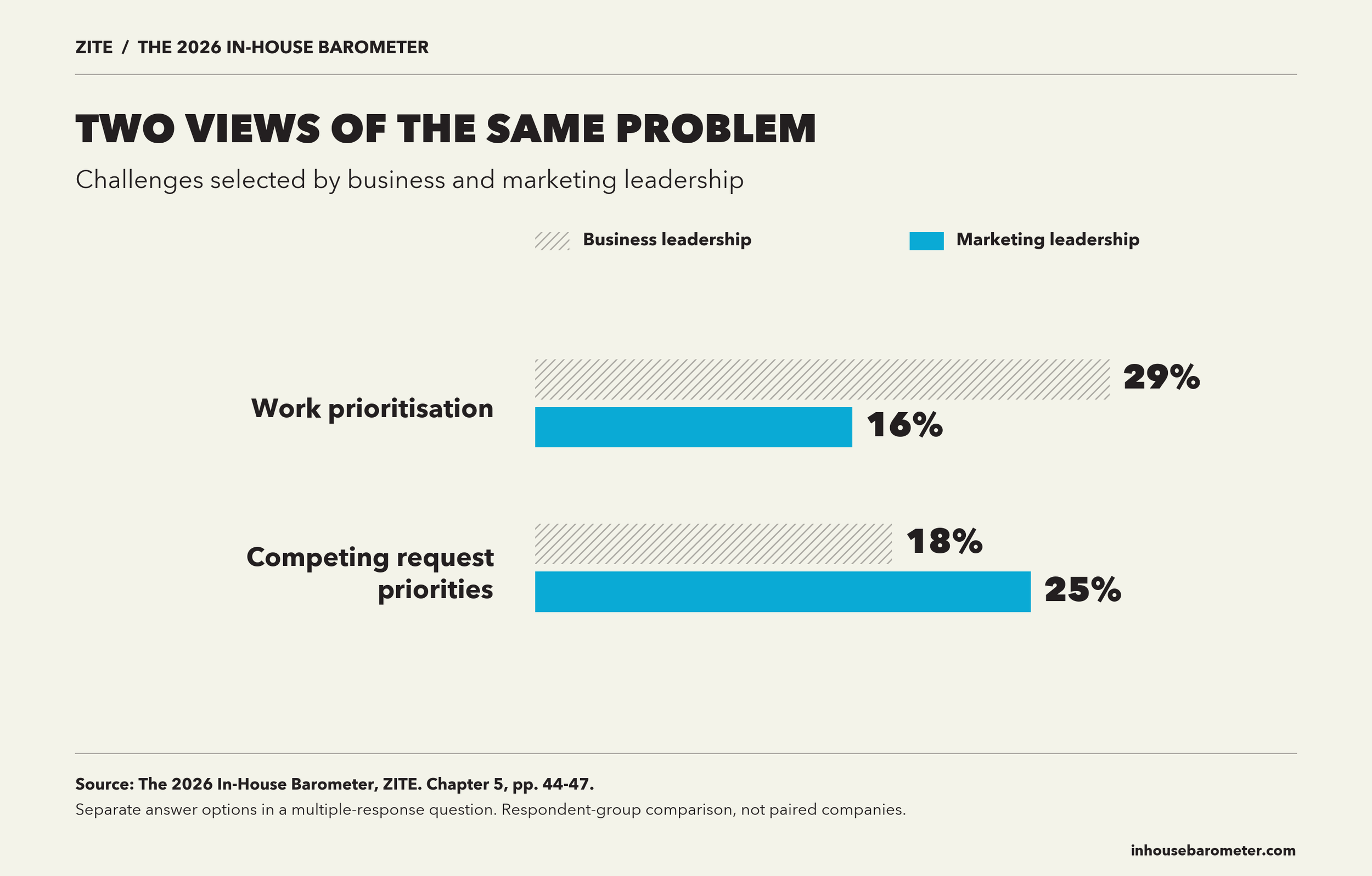
Business leaders more often select work prioritisation; marketing leaders more often select competing request priorities. The categories are not mutually exclusive.
These are separate answer options, not two groups of people who necessarily disagree about everything. Nor does the survey show paired conversations within the same companies. What it does reveal is a difference between respondent groups: business leaders more often select prioritisation itself, while marketing leaders more often select the competing demands entering the team.
A queue is not necessarily a team failure
Our interpretation is that the same visible delay can have different causes. Sometimes marketing genuinely needs better planning, clearer estimates or stronger project management. Sometimes several parts of the business have made incompatible promises about the same capacity. The second problem cannot be solved entirely by the people receiving the requests.
Consider a launch deadline that cannot move because media has already been booked. An urgent presentation then arrives for a senior executive. There are choices: reduce the presentation’s scope, use an approved template, bring in extra support or move another commitment. What is not a choice is to pretend that accepting the presentation has no consequence.
That is the conversation prioritisation should create. Instead of telling a stakeholder that the team is busy, show what their request would displace and who needs to approve that trade-off. It turns a dispute about responsiveness into a decision about the business.
Make the cost of “yes” visible
A useful intake process asks for the business problem, the required outcome, the real deadline and the person accountable for the decision. It also distinguishes the requested deliverables from the problem they are supposed to solve. A request for twenty assets may turn out to need five, or a sales team may already have something suitable in the asset library.
Capacity planning then has to include the work that is easy to forget: briefing, reviews, revisions and handovers. Booking a designer for a first draft is not the same as reserving the capacity required to finish an assignment. Teams also need a route for genuinely unexpected work, rather than treating every interruption as either a crisis or a rule violation.
The point is not to remove the responsiveness that makes in-house valuable. It is to protect it. A business that can distinguish an unexpected market opportunity from a late internal request is better placed to decide when rapid intervention is worth the disruption.
An organisational decision needs an owner
Marketing should own the clarity of its estimates and the discipline of its workflow. Business leadership should own conflicts between business priorities. Creative leadership should have a say when a proposed shortcut threatens the idea. Operations connects those decisions to the people and time required to deliver them. Without that division, the project manager becomes the person politely apologising for decisions nobody made.
For ZITE, this is part of designing and running an in-house setup, rather than simply supplying extra capacity. The work includes how requests enter, how resources are allocated and how teams and partners operate together. More people can be the right answer, but they should join a setup that knows what it needs them to do.
A useful starting point for the next planning meeting is to review the most recent urgent request. What did it interrupt, who approved the change and was the trade-off recorded? That small exercise will reveal more about prioritisation than asking everyone to be better at saying no.
Explore the leadership differences and operational findings in the 2026 In-House Barometer.