What Do the Best Marketing Teams Do Better?
They make the important decisions before the work becomes urgent. That takes more than talented people and a better project board.
A marketing department can look reassuringly professional from the outside. There is a Creative Director, a workflow platform and a calendar full of campaigns. The more revealing moment comes when a senior stakeholder asks for something unexpected. Who decides whether it should happen? What moves to make room? And does the answer depend on the business case or on who sent the message?
Those questions get closer to maturity than team size or years in operation. The 2026 In-House Barometer, based on 1,114 interviews across 17 countries, does not rank the world’s best marketing teams. Its final chapter instead identifiespractices that can help organisations make more deliberate choices. That distinction matters: this is a useful management framework, not a league table.
In the foreword, I describe maturity as “the quality of the choices around” the team. A large department can still work through favours and interruptions. A smaller one can have clear responsibilities, protected thinking time and access to specialists it could never justify employing permanently.
They decide what the team is for
The first decision is the mandate. An internal creative team should not inherit every task it has once agreed to complete. Its purpose might include brand development, campaign creation, recurring production or a combination. What matters is that the business knows what it is funding, what the team owns and where its responsibilities stop. Otherwise, an apparently helpful service gradually becomes an unlimited promise.
The second decision is how different work should move. Developing a brand platform and adapting an approved banner do not need identical workflows. One needs exploration and senior judgement. The other may need a template, accurate product information and a quick approval. Putting both through the same process can either burden production with unnecessary meetings or squeeze strategic work into production deadlines.
They give operations authority, not just a title
The report finds an Operations Director in 43% of larger organisations with in-house resources, compared with 29% of smaller ones. This is a company-size comparison, not proof that larger companies perform better. It does, however, show that dedicated operational leadership is more common where the organisation is larger.
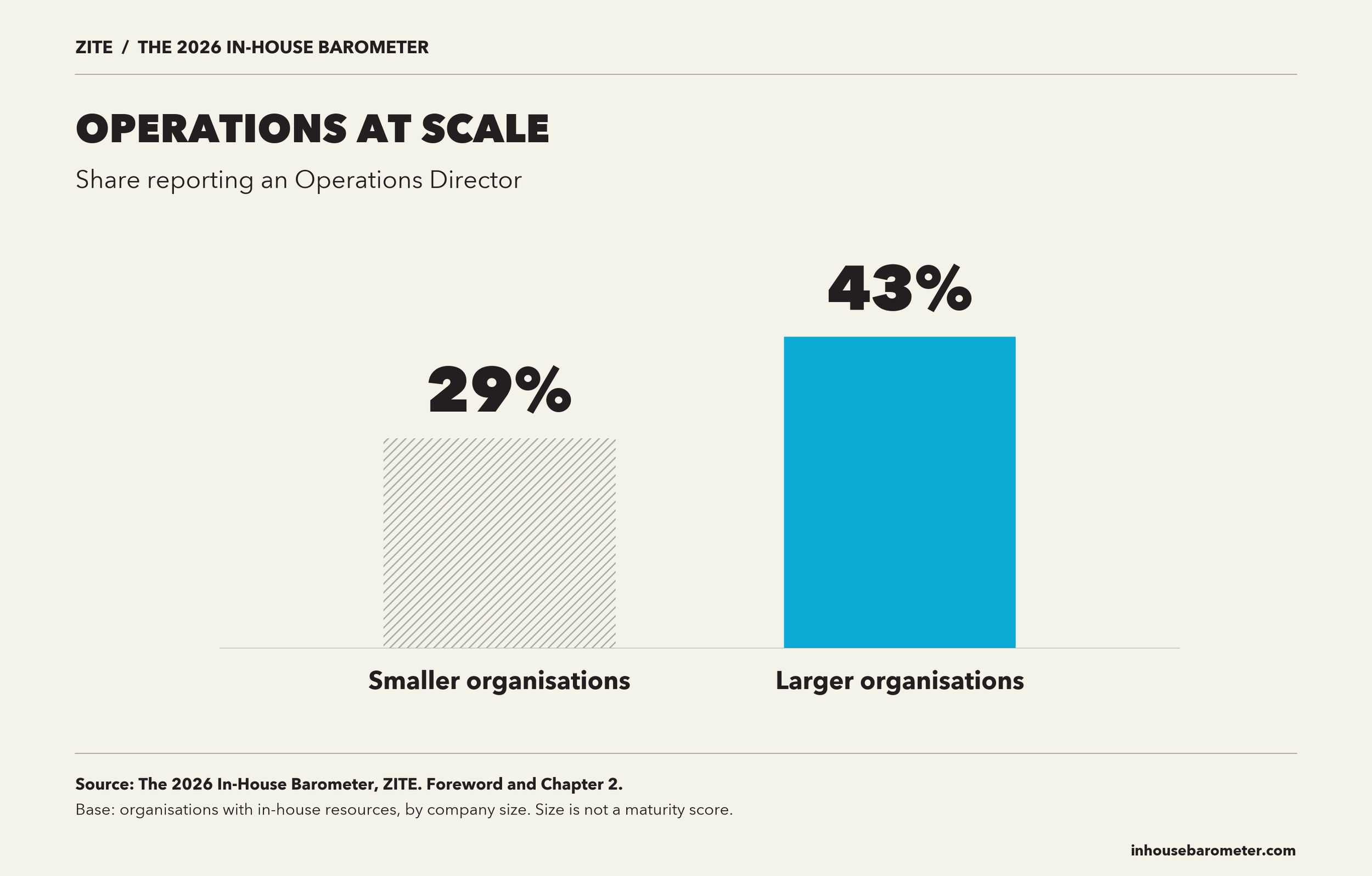
Operational leadership is more common in larger organisations with in-house resources. The chart compares company-size groups, not performance or changes over time.
That leadership should do more than keep a status report tidy. It needs to make capacity visible, plan for review rounds, connect dependencies and show the consequences of accepting new work. When two senior stakeholders want the same people at the same time, somebody with business authority must resolve the conflict. A beautifully maintained board cannot make that decision on their behalf.
They do not ask marketing managers to invent another profession
Knowing the customer and setting a commercial direction are not the same skills as designing a production network. Creative Orchestration combines both perspectives without pretending they are interchangeable. It connects creative judgement, resource planning, internal teams, agencies, specialists and AI through a shared way of working. Project management remains essential, but it is one part of the discipline rather than the whole of it.
The tools matter too. An approved brief should remain connected to the assignment, the latest feedback and the final assets. Capacity decisions need current information. Brand knowledge must be available to the next person, not trapped in the previous person’s inbox. Technology makes those connections usable at scale, provided the organisation has first agreed who can decide what.
This is also why external operating expertise can belong inside an in-house model. At ZITE, we design and run embedded teams, bringing processes, technology and access to a wider specialist network. The client keeps proximity to its business; it does not have to build every piece of agency-operating expertise from scratch.
The practical test is simple. Pick a live campaign and trace its decisions from the original business problem to the final approval. Wherever ownership disappears, there is something to fix. The answer may be a clearer mandate, a different workflow, a specialist partner or a better-connected tool. It is not automatically another hire.
Read the 2026 In-House Barometer for the evidence and a fuller framework for examining your own setup.